
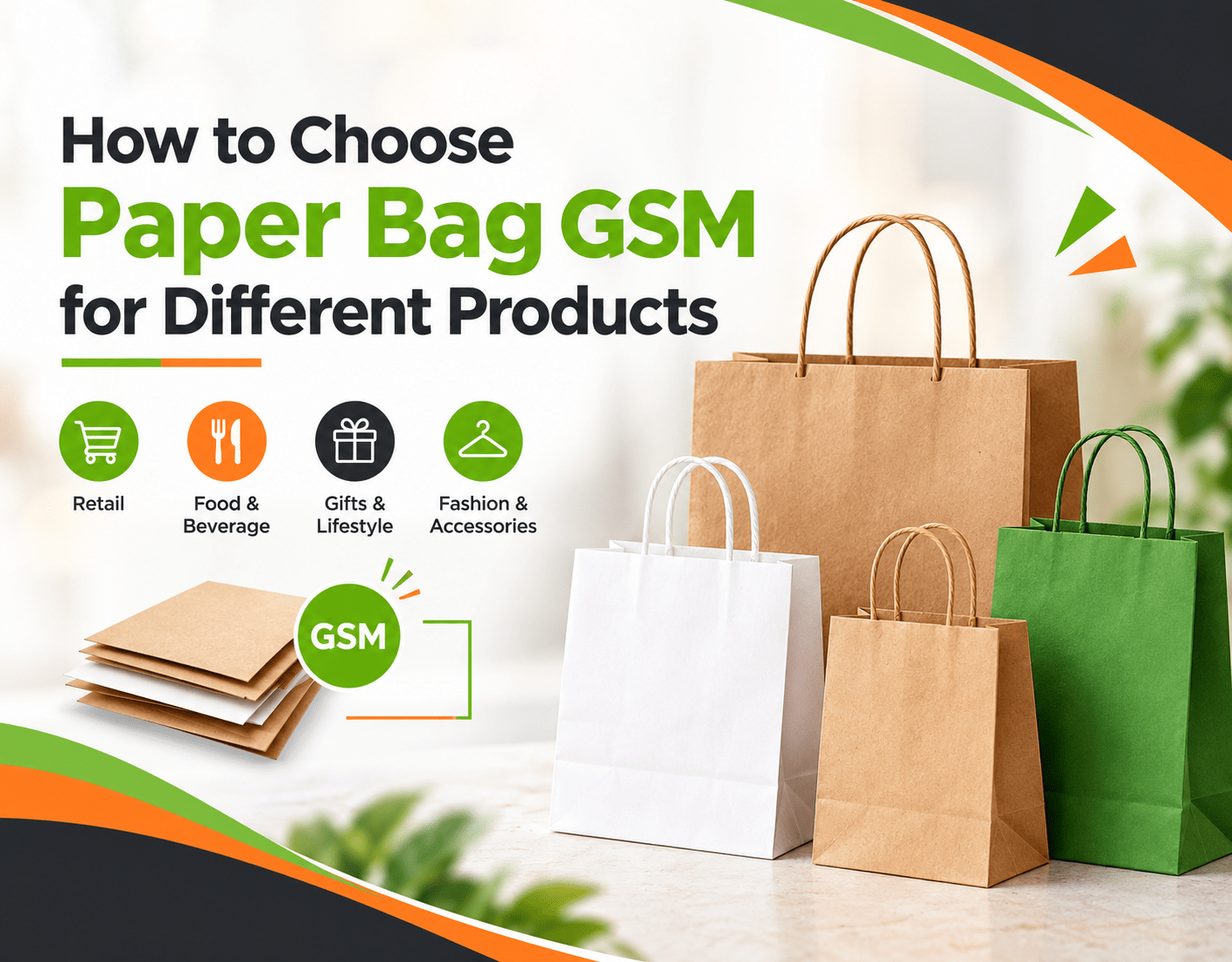
When ordering custom paper bags, one of the first questions is often: “What GSM do I need?” GSM matters, but the right choice also depends on the product weight, bag size, base construction, handles and intended use.
The best approach is to start with the products the bag will carry. Consider their total packed weight, dimensions, quantity per purchase and how the bag will be used. This helps retailers, bakeries, restaurants, boutiques and gift businesses choose a practical specification that balances performance, cost and presentation.
What Does GSM Mean in Paper Bags?
GSM means Grams Per Square Metre. It measures the weight of paper across a standard area and is commonly used to compare paper stocks. Generally, a higher GSM paper feels more substantial, but GSM alone does not determine how a finished paper bag will perform.
GSM and paper thickness are not the same
GSM measures paper weight, while thickness is a separate measurement. Two papers with a similar GSM can have different thickness, stiffness and surface characteristics depending on their fibre content, processing and paper grade.
For this reason, GSM should be treated as a starting point when selecting a paper bag specification rather than a guarantee of carrying capacity.
How to Choose GSM Based on Your Product
Different products create different requirements for a paper bag. Start by considering the complete packed order rather than the weight of an individual item.
Clothing, Fashion and Accessories
Clothing is often relatively light but can take up considerable space. A larger bag may need a more substantial paper stock and suitable handles, particularly when it contains garments, shoes or accessories.
For fashion and boutique retail, appearance also matters. Paper selection, printing and finishing can be chosen to create the desired brand experience without unnecessarily over-specifying the paper.
Bakery and Confectionery Products
Bakery orders should be assessed as a complete packed order. A cake or dessert box combined with drinks and smaller items can create a significant load.
Consider:
- Cake or dessert box dimensions
- Total packed weight
- Base stability
- Possible grease or moisture exposure
- Number of items per order
Restaurant and Takeaway Orders
Takeaway bags often carry several containers, drinks, sauces and side dishes. The combined weight and how the contents are distributed inside the bag are important.
Consider the typical order as well as a heavier realistic order scenario when selecting the paper and construction.
Gift, Premium Retail and Stationery
For gift shops, beauty brands, stationery retailers and premium businesses, the bag can be part of the overall customer experience.
Books and notebooks, for example, may be compact but relatively dense. A suitable bag should therefore combine the desired tactile and visual appearance with a base and handle construction appropriate for the product.
Electronics and Other Heavier Products
Compact, dense or awkward products require more careful consideration. Look at the product weight, dimensions, bag size, base design and handle attachment together.
Instead of selecting a GSM based only on how the paper feels, test a finished sample with the actual product before placing a larger production order.
Factors to Consider Beyond Paper Bag GSM
GSM is only one part of a complete paper bag specification. Other important factors include:
| Factor | Why it matters | What to check |
| Paper type and finish | Affects appearance, feel and print result | Does the stock suit the branding and intended use? |
| Bag dimensions | Size affects how the load is distributed | Check width, gusset, height and how the packed item sits inside. |
| Handle construction | Handle attachment can be a key stress point | Review handle type and reinforcement requirements |
| Bottom construction | Supports the contents and distributes the load | Consider the appropriate folded, flat or reinforced base |
| Printing and finishing | Influences appearance and material requirements | Confirm print coverage, colours and finishing with the supplier |
At KS Packaging, we produce custom paper bags for industries including F&B, cafés, bakeries, retail, corporate events, beauty, wellness and luxury. Options can range from simple kraft paper bags to premium designs with finishes such as matte surfaces and foil stamping.
See KS Packaging’s custom paper bags to discuss a specification based on your products, packaging requirements and brand presentation.
Paper Bag GSM Guide by Business Type
The ranges below are practical starting points, not fixed rules. The final GSM should be confirmed based on the paper grade, bag dimensions, construction, handles, printing requirements and actual product load.
| Business type | Practical starting GSM range | Key consideration |
| Bakery | 120 – 250 GSM | Consider cake or dessert box size, total order weight and base stability. |
| Fashion retail | 120 – 250 GSM | Balance garment volume, shoe-box weight, presentation and handle strength. |
| Restaurant / takeaway | 80 – 140 GSM | Consider the combined weight of food containers, drinks and sauces. |
| Gift shop | 120 – 170 GSM | Focus on product weight, presentation and the desired tactile feel. |
| Bookstore / stationery | 120 – 170 GSM | Books can be compact but heavy, so base and handle construction are important. |
| Promotional use | 80 – 120 GSM | Match the paper to the expected contents, carrying duration and event requirements. |
| Heavy retail / electronics | 200 – 250 GSM | Requires careful assessment of product weight, dimensions and complete bag construction. |
Important: These GSM ranges should not be treated as standalone load-capacity specifications. A larger bag carrying the same product can experience different stresses from a smaller bag, while handle attachment and bottom construction can significantly affect performance
How to Test Whether a Paper Bag Is Strong Enough
Before ordering a large quantity of custom paper bags, it is useful to test the finished bag with the products it will actually carry.
- Check the actual product weight
Calculate the total weight of the products and packaging that will go inside the bag, including a realistic heavier order scenario. - Check the bag dimensions
Consider how the width, height and gusset affect the way the products sit and how the load is distributed. - Test the handles
Check the handle attachment points for tearing, loosening, paper damage or excessive stretching. Reinforcement may be required for heavier applications. - Test the bottom
Place the intended load inside the finished bag and check whether the bottom remains stable, paying attention to seams and folded areas. - Conduct a real-world test
Use the finished bag with the actual product combination. Lift it, move it and assess how it performs under realistic conditions before approving the final specification.
If the sample does not perform as expected, the specification may need to be adjusted. This could involve the GSM, paper type, dimensions, handles or construction.
Common Mistakes When Choosing GSM for Paper Bags
Choosing paper bag GSM based on price or thickness alone can result in the wrong specification. Here are some common mistakes to avoid when selecting GSM for custom paper bags.
Choosing by price alone
Reducing paper weight may lower the initial unit cost, but it is not a saving if the result is poorly suited to the product or undermines the customer’s carrying experience. Compare the whole specification, not only the GSM number.
Assuming higher GSM is automatically better
Over-specifying the paper can add cost and material without resolving the real weakness. If the bag is too wide, the handle attachment is unsuitable or the base needs attention, a higher GSM alone may not solve the problem.
Ignoring bag dimensions and handles
A bag’s width, height and gusset change how the load is distributed. Handles are equally important: the customer interacts with them first, and an otherwise robust bag can fail at the attachment point. Treat the bag as a complete construction.
Approving from an empty sample
An empty bag can feel convincing while giving little information about in-use performance. Always test it with the intended product mix. If a specific load rating is needed, request supplier guidance based on the final construction and verify it through an appropriate test rather than relying on a general GSM rule of thumb.
Conclusion
Choosing the right paper bag GSM is about matching the paper to the product and the way the bag will be used. Product weight, bag dimensions, handles, base construction, printing and finishing all contribute to the final specification.
At KS Packaging, we offer custom paper bags with finishing options including hot stamping, Spot UV, embossing/debossing, velvet lamination, refraction printing and texture effects. The right combination can help your packaging deliver both practical performance and a strong brand presentation.
Planning custom paper bags for your business? Share your product size, packed weight, expected quantity per order and artwork or finishing requirements with KS Packaging. Our team can help you determine a suitable paper bag specification for your application.
Contact KS Packaging to discuss your custom paper bag requirements.
Frequently Asked Questions
1. What GSM is best for paper bags?
There is no single best GSM for every application. As a general starting point, paper bags may range from around 80 GSM for lighter promotional or takeaway applications to 200+ GSM for heavier or more premium uses. The final choice should be based on the product, bag size and construction.
2. Is higher GSM always better for paper bags?
No. Higher GSM can provide a more substantial feel, but it does not automatically make a bag suitable for every application. Dimensions, paper grade, handles and base construction also need to be considered.
3. What GSM is suitable for clothing and fashion bags?
A practical starting range is around 120 – 250 GSM, depending on the bag size, number of garments, shoe boxes and desired presentation. The final specification should be tested with the intended products.
4. What GSM is suitable for bakery and takeaway bags?
Bakery bags generally range from 120 – 250 GSM, while takeaway applications may start around 80 – 140 GSM. The appropriate range depends on the complete order weight, container sizes and bag construction.
5. How do I choose the right GSM for custom paper bags?
Start by providing the supplier with your product dimensions, packed weight, typical order quantity, bag size, artwork and finishing requirements. A finished sample should then be tested with the intended products before a large production order.