
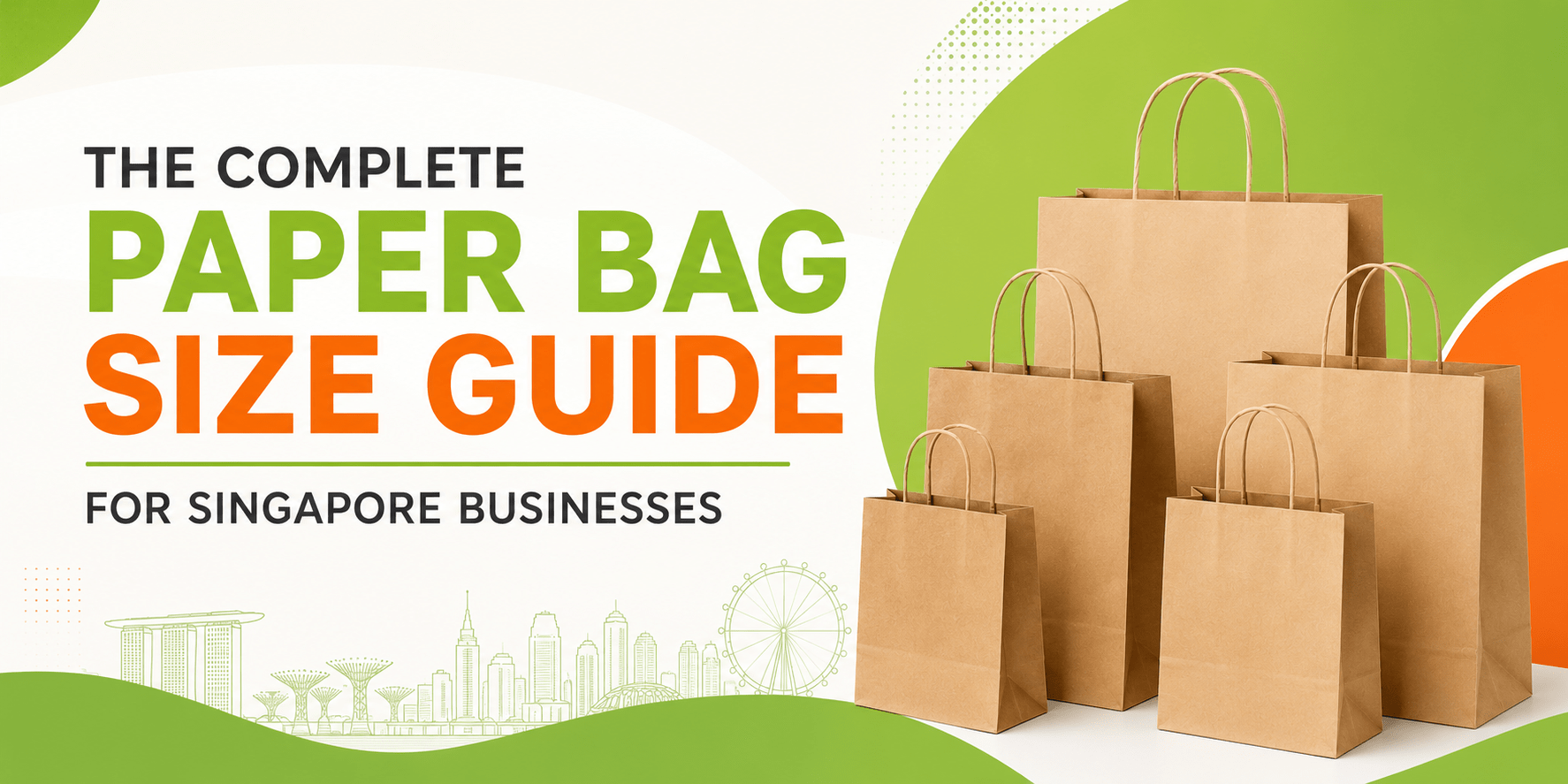
Choosing the right paper bag size sounds simple until you are standing at the counter, watching a staff member struggle to fold a gift box into a bag two sizes too small or handing a customer a bag so large it dwarfs a single candle inside. Size matters enormously in retail packaging, and for Singapore businesses operating in one of Asia’s most competitive markets, getting it right is not optional.
This guide breaks down everything you need to know about paper bag dimensions—from the smallest jewellery pouches to oversized carrier bags used in furniture and lifestyle retail—so your packaging works as hard as your products do.
Why Paper Bag Size Matters for Businesses
Paper bags are more than simple carriers for products. They represent your brand long after a customer leaves your store. When businesses choose the correct paper bag dimensions, they create a better overall experience for customers.
Here’s why size selection matters:
Better Product Protection
Products need enough space to fit comfortably without being squeezed or damaged. Proper sizing prevents issues such as torn packaging, crushed items, or spilled contents.
Improved Brand Presentation
A perfectly sized paper bag creates a premium and polished appearance. Luxury brands, cafés, and retail stores often use custom-sized bags to strengthen brand identity.
Cost Efficiency
Oversized bags use more material, increase production costs, and occupy additional storage space. Proper sizing helps businesses save money on manufacturing and logistics.
Environmental Benefits
Singapore consumers are becoming increasingly eco-conscious. Using appropriately sized paper bags reduces unnecessary paper waste and supports sustainability goals.
Easier Storage and Transportation
Businesses that order the correct bag sizes can optimize warehouse storage and simplify product packing processes.
How Paper Bag Dimensions Are Measured
Before diving into sizes, it helps to understand the three dimensions you will always see quoted:
- Length (L) — the front-to-back measurement when the bag is lying flat
- Width (W) — the side expansion that gives the bag its three-dimensional base
- Height (H) — how tall the bag stands vertically
When a bag is described as L × W × H, the width is the depth of the bag when it is opened and standing upright. A bag listed as 25 cm × 12 cm × 30 cm, for example, is 25 cm long, 12 cm wide, and 30 cm tall.
Always measure your product at its widest and tallest points—and add at least 3–5 cm of clearance on each dimension so the bag closes neatly without squashing the contents.
Standard Paper Bag Sizes in Singapore
The Singapore market uses a fairly consistent set of sizes across retail, food and beverage, and corporate gifting. Here is a breakdown of the most common categories:
1. Extra Small (XS) — Jewellery, Accessories, Sachets
| Dimension | Measurement |
| Length | 12–15 cm |
| Width | 6–8 cm |
| Height | 15–18 cm |
Best for: Jewellery, accessories, small cosmetic items, name cards, gift vouchers, single sachets
These compact bags are popular with jewellery retailers and boutique gift shops. Because the footprint is small, they are often produced in high-quality kraft or art paper with ribbon handles to reinforce a premium feel. If your product is lightweight and small, do not default to a bigger bag just to look generous — an XS bag done well looks far more intentional.
2. Small (S) — Gifts, Single Garments, Books
| Dimension | Measurement |
| Length | 18–22 cm |
| Width | 8–10 cm |
| Height | 22–26 cm |
Best for: Folded clothing items, single books, cosmetics, small gift sets, shoe accessories
Small bags cover a wide range of retail needs. They are the workhorse for fashion accessories, stationery brands, and specialty food items like premium tea or chocolates. In Singapore’s gift culture — especially during Chinese New Year, Deepavali, and Christmas — small bags in this range are in extremely high demand. If you do seasonal packaging, this is the size to stock.
3. Medium (M) — Apparel, Shoes, Mid-Size Retail
| Dimension | Measurement |
| Length | 25–30 cm |
| Width | 12–15 cm |
| Height | 28–35 cm |
Best for: Folded apparel, shoeboxes up to a size 8, mid-range gift hampers, electronics accessories, lunch set packaging
This is the most commonly ordered size across Singapore’s retail sector. Fashion retailers, pharmacies, mid-tier gift shops, and even some hawker stall operators offering takeaway bento sets gravitate toward this range. If you are unsure where to start, a medium bag at approximately 28 cm × 13 cm × 32 cm (L × W × H) will handle the majority of everyday retail use cases.
4. Large (L) — Bulk Retail, Hampers, Apparel Sets
| Dimension | Measurement |
| Length | 32–38 cm |
| Width | 15–18 cm |
| Height | 36–42 cm |
Best for: Multiple garments, festive hampers, large shoeboxes, homeware items, bundles and combo sets
Large bags are popular during gifting seasons and with businesses that often package multiple items together. Supermarkets, department stores, and corporate gifting companies in Singapore rely heavily on this size. The structural demand is higher here — look for bags with twisted rope handles or flat ribbon handles rather than die-cut holes, which can tear under heavier loads.
5. Extra Large (XL) — Corporate, Hospitality, Bulk Orders
| Dimension | Measurement |
| Length | 40–50 cm |
| Width | 18–25 cm |
| Height | 45–55 cm |
Best for: Hotel amenity kits, corporate welcome packs, large gift hampers, event merchandise bags, bulk food packs
XL paper bags are less common in day-to-day retail but essential for hospitality brands, event companies, and large-format gifting. At this size, the paper weight and handle reinforcement become critical — minimum 150 gsm art paper or 120 gsm kraft is recommended.
Special Formats: Bottle Bags and Square-Base Bags
Bottle bags have a tall, narrow profile, typically around 12cm × 9cm × 36cm. They are designed for wine, spirits, and long-stem flowers—increasingly popular with florists and premium wine retailers in Singapore.
Square-base bags have equal width and gusset dimensions (e.g., 20cm × 20cm × 30cm), which makes them ideal for boxed cakes, lantern festival items, and square gift boxes. Bakeries and patisseries in Singapore frequently use this format.
Paper Weight and Handle Type: The Other Half of the Decision
Dimensions are only one part of the specification. Two other factors dramatically affect how your bag performs:
Paper weight (gsm):
- 150–170 gsm — lightweight promotional bags, low-load items
- 200 gsm — standard retail bags, suitable for most apparel and gifts
- 250 gsm — premium retail, heavy items, luxury branding
Handle types:
- Twisted paper handles — affordable, widely used, handles up to 3–5kg
- Flat ribbon handles — premium appearance, common in fashion and luxury retail
- Die-cut handles — clean look for lightweight bags, not suitable for heavy loads
- Cotton rope handles — high-end and durable, popular for corporate gifting
A Quick Reference: Matching Your Product to the Right Size
| Product Type | Recommended Size |
| Jewellery / Small accessories | XS |
| Single book / Cosmetics | S |
| Folded apparel / Shoes | M |
| Multiple garments / Hampers | L |
| Corporate gift packs / Event bags | XL |
| Wine / Bottles / Flowers | Bottle bag |
| Boxed cakes / Square gifts | Square-base bag |
Ordering Tips for Singapore Businesses
Order a sample run first. Before committing to 5,000 units, request a physical sample in your chosen size. Fill it with your actual product. Check the handle tension, the base stability, and how the bag looks when sealed or folded closed.
Factor in your packing workflow. Bags that are marginally too small become a daily frustration for your packing team. Give yourself working clearance — especially for F&B items with irregular shapes or items packed with tissue paper.
Plan for seasonal spikes. Singapore’s retail calendar has clear peaks: Chinese New Year (January–February), Hari Raya (varies), National Day (August), and year-end Christmas. Order your festive packaging at least 6–8 weeks ahead to avoid rushed lead times.
Standardise where possible. Carrying too many sizes inflates storage needs and minimum order quantities. Most businesses can cover 90% of their use cases with two well-chosen sizes.
Conclusion
Paper bag sizing is not a one-size-fits-all decision, but it does not have to be complicated either. With a clear understanding of your product dimensions, weight, and the impression you want to leave, you can narrow down your options quickly.
At KS Packaging, we work with Singapore businesses of every size — from single-outlet boutiques to multi-location retail chains — to source paper bags that match their products, brand, and budget. Whether you need standard stock sizes or custom dimensions with your logo, our team is ready to help you get it right from the first order.
Get in touch with KS Packaging today to request samples, discuss custom sizing, or explore our full range of sustainable paper bag options for Singapore businesses.